

Cancer in women-early detection and prevention should be the policy. Cancer cases as well as deaths due to cancer are increasing rapidly among Indian women, primarily because of low awareness and late detection. India accounts for the third highest number of cancer cases among women. In India, the word cancer is extremely stigmatized. Women in India fear that their reputation and that of their families would suffer if people knew of their cancer diagnosis and shame increases when cancer involves the reproductive system. Other factors include ignorance, fear, poverty, poor accessibility, gender discrimination and sometimes apathy of health professionals and policy makers.
 Breast cancer is currently the most common cancer among Indian women, both in terms of incidence as well as mortality. More than 50% of breast cancer patients in India are suffering from stage 3 and 4, where the chances of survival are extremely low. Awareness is the key here. Women need to be educated about risk factors and breast cancer symptoms. A large number of factors are identified as risk factors for breast cancer. Late age at first pregnancy (greater than 30 years), single child or no child, early age at menarche and late age at menopause, obesity are some of the risk factors.
One cannot prevent breast cancer but can increase the survival rates by early detection and choosing the right treatment at the right time. Mammographic screening for breast cancer may not be cost effective in India at present, but regular breast self·examination and clinical breast examination need to be promoted. The screening guidelines can be adopted based on the age and the risk.
Cervical Cancer is the second most common form of cancer in Indian Women. Cervical cancer is preventable and curable if detected early. Now it is a known fact that cervical cancer is caused by a human papilloma virus (HPV) infection. So vaccines are available to prevent HPV infection and thereby cancer. Multiple sexual partners, early age at marriage and poor genital hygiene are some of the risk factors for cervical cancer. Cervical cytology (pap smear} screening programs were found to be successful in reducing cervical cancer incidence.
 Recently HPV testing has been introduced for screening. Again given the limitations in large scale population based screening programs; India can consider primary prevention of cervical cancer by promoting genital hygiene and vaccination. Low resource based methods like visual inspection with acetic acid (VIA) has been accepted as a screening method.
By implementing resource-appropriate strategies on prevention, early detection and treatment, millions of lives can be saved every year. Through raising the public and political awareness about cancer, we can reduce fear, increase understanding, dispel myths and misconceptions, and change behaviours and attitudes towards cancer.
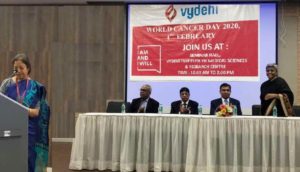
As a part of this program, Vydehi Cancer center will be organizing multiple free cancer screening camps in and around Bengaluru. To mark World Cancer Day, Vydehi Cancer Center organized an event at their Institute on February 4th. Dr Shailesh Shrikhande ,Deputy Director of Tata Memorial Hospital, Mumbai presided over the event as chief guest. Dr Uma Nambiar, a senior neurosurgeon and International healthcare consultant was guest of honour.

Dr. Geeta S.Narayanan
Vydehi Cancer Center,DKA Oncology block
Vydehi Hospital, Bengaluru-66
Ph:080-41663864, 080-28413381-85