

Child sexual abuse is the involvement of a child in sexual action that child does not fully understand, is not able to give consent to, or that violates the laws or social taboos of society.
Dr M.Padmajarani
Child abuse or maltreatment comprise all ways of physical, emotional or sexual abuse, negligent treatment and commercial exploitations, leading to potential harm to the child’s health, development, dignity or trust to a person under the age of eighteen.
Child sexual abuse refers to a situation where an adult utilize a child for sexual inspiration. Filthy spotlight (of the genitals, female nipples, etc.) to a child with purpose of indulging sexual desires, physical contact with a child, or using a child to produce child pornography.
Sexual abuse comprise:
• Assault, including rape and sodomy
• Touching or Fondling a child
• Exhibitionism- Forcing a child to exhibit his/her private body parts
• Photographing a child in nude
• Aggressive kissing
• Sexual press on a child while travelling or marriage situations
• Divulging a child to pornographic equipment
Who commits the crime?
Child Sexual abuse can be committed by person who take care of a child including family members, relatives, friends, doctors, other medical personnel and tutor. Unfortunately this is done to satisfy the desires of the other person. These may take account of but is not limited to:
- Compulsion of a child to slot in in any unlawful action.
- Manipulative use of a child in prostitution or other unlawful sexual activities.
- Exploiting child through pornography.
Effects
- Psychological effects: Abuse may have both short-term and long-term harm, including psychopathology in later life. It leads to depression, anxiety, eating disorders, poor self-esteem, sleep disturbances, and dissociative and anxiety disorders. Children may go regressive in behaviours like thumb-sucking and bed-wetting. Victims may refuse to go to school, involve in social activities, learning and behavioural problems, attention deficit/hyperactivity disorder (ADHD), conduct disorder, and oppositional defiant disorder (ODD). Child sexual abuse victims are reported almost four times as many incidences of self-inflicted harm.
- Injury: Depending on the age and size of the child, and the degree of force used, child sexual abuse may cause internal lacerations and bleeding. In severe cases, damage to internal organs may occur, which, in some cases, may cause death. Causes of death included trauma to the genitalia and sexual mutilation.
- Infections: It may cause infections and sexually transmitted aliments. Depending on the age of the child, due to a lack of sufficient vaginal fluid, chances of infections are higher. Vaginitis has also been reported.
- Neurological damage: Traumatic stress may causes remarkable changes in brain functioning and development. It also leads to reduced corpus callosum area and increased electrophysiological abnormalities .
How to talk to kids about abuse
Talking about abuse is an not easy task. Nevertheless, like many significant dialogue, it’s not something to remain to talk about until it comes up on its own. Indeed, by then it may be very late.
Getting Started…
Child at 4 yrs age can comprehend the basic notions of good touches, bad touches and confusing touches.
So, please mark on calendar to sit with children to talk about these 3 matters:
Describe the 3 different types of touch
- Good touches are those touches that make us feel happy, safe and loved. Most of the touch we get is good touch.
- Bad touches are those touches that hurt us; they feel like an “ouch.” Examples are kicking, hitting and biting.
- Sexual abuse touch is explained as “forced or tricked touch of private body parts.” The key words are forced and tricked.
Teach child that a some one is forced to do something you don’t want to do or don’t understand. Or they play a trick where someone lies, fools, pretends or calls something a game, that isn’t a game, so they can touch private body parts or have touch theirs.
Tell children that sexual abuse is confusing because it doesn’t necessarily hurt; the touch can feel good, but it is not okay.
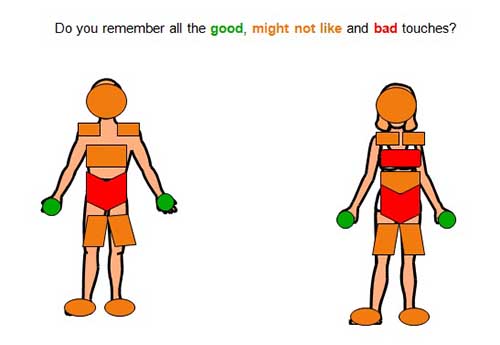
Tell them it’s okay to speak up: Teach child that when abuse happens, it’s never the child’s fault and that it is okay to break promises they make about abuse.
Keep the conversation going: As you talk with your children about abuse, keep in mind that you may need to revisit the discussion as they get older.
Teach child The Underwear Rule: About one in five children falls victim to sexual violence, including sexual abuse. Help child to prevent this. Teach them that a a part which is covered by underwear should not be touched by others, nor they should touch others.
The Underwear Rule has 5 important aspects.
- Your body is your own: Children should be taught that their body belongs to them and no one can touch it without their permission. Children have the right to refuse a kiss or a touch, even from a person they love. Children should be taught to say “No”, immediately and firmly, to inappropriate physical contact, to get away from unsafe situations and to tell a trusted adult.
- Good touch – bad touch: Children do not always recognise appropriate and inappropriate touching. Tell children it is not okay if someone looks at or touches their private parts or asks them to look at or touch someone else’s private parts. The Underwear Rule helps them to recognise an obvious, easy-to-remember border: the underwear.
- Good secrets – bad secrets: Secrecy is a main tactic of sexual abusers. That’s why it’s important to teach the difference between good and bad secrets and to create a climate of confidence. Every secret that makes them anxious, uncomfortable, fearful or sad is not good and should not be kept; it should be told to a trustworthy adult (parent, teacher, police officer, doctor).
Other helpful hints to accompany The Underwear Rule
- Prevention and protection are the responsibility of an adult: When children are abused they feel shame, guilt and fear. Adults should avoid creating taboos around sexuality, and make sure children know whom to turn to if they are worried, anxious or sad. Children may feel that something is wrong. Adults should be attentive and receptive to their feelings and behaviour. There may be many reasons why a child refuses contact with another adult or with another child. This should be respected. Children should always feel that they can talk to their parents about this issue.
- Reporting and disclosure : Children need to be instructed about adults who can be part of their safety network. They should be encouraged to select adults whom they can trust, are available and ready to listen and help. Only one member of the safety network should live with the child; the other should live outside the immediate family circle. Children should know how to seek help from such a trust network.
- Known perpetrators: In most cases the perpetrator is someone known to the child. It is especially difficult for young children to understand that someone who knows them could abuse them. Keep in mind the grooming process that abusers use to win the trust of children. Informing parents regularly about someone who gives gifts, asks to keep secrets or tries to spend time alone with a child must be a set rule in the house.
- Unknown perpetrators : In some cases the perpetrator is a stranger. Teach your child simple rules about contact with strangers: never get into a car with a stranger, never accept gifts or invitations from a stranger.
- Help : Children should know that there are professionals that can be particularly helpful (teachers, social workers, ombudspersons, physicians, the school psychologist, the police) and that there are help lines that children can call to seek advice.
Why The Underwear Rule?
About one in five children falls victim to some form of sexual abuse and violence. It happens to children of every gender, every age, every skin colour, every social class and every religion. The perpetrator is often someone the child knows and trusts. The perpetrator can also be a child. You can help prevent this happening to your child.
Good communication with children is the key. It implies openness, determination, straightforwardness and a friendly, non-intimidating atmosphere.
The Underwear Rule can help you with this
A child is never too young to be taught The Underwear Rule because abuse can happen at every age. If you find it uncomfortable to talk about this subject with your child, please remember that it is probably more difficult for you as an adult than it is for a child.
What to do if you suspect abuse
- When you suspect your child has been abused, it is very important not to be angry with your child.
- Do not make your child feel as if they have done something wrong.
- Do not interrogate the child.
- You could ask what may have happened, when and with whom, but do not ask why it happened.
- Try not to be upset in front of your child. Children can easily feel guilty and may hold back information.
- Try not to jump to conclusions based on little or unclear information.
- Reassure your child that you will do something about it, and contact someone who could help, like a psychologist, child care specialist, doctor, social worker or the police.
- special help lines and centres responsible for helping child victims of sexual violence have been set up.
How to response
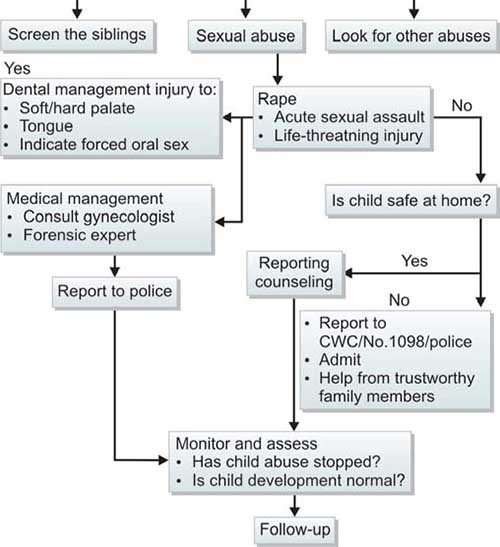
Treatment
The initial approach to treating a person who has been a victim of sexual abuse is dependant upon several important factors:
- Age at the time of presentation
- Circumstances of presentation for treatment
- Co-morbid conditions
The goal of treatment is not only to treat current mental health issues, but to prevent future ones.
Children often present for treatment in one of several circumstances, including criminal investigations, custody battles, problematic behaviours, and referrals from child welfare agencies. The three major modalities for therapy with children and teenagers are family therapy, group therapy, and Individual therapy.
Which course is used depends on a variety of factors that must be assessed on a case by case basis. For instance, treatment of young children generally requires strong parental involvement, and can benefit from family therapy. Adolescents tend to be more independent, and can benefit from individual or group therapy. The modality also shifts during the course of treatment, for example group therapy is rarely used in the initial stages, as the subject matter is very personal and/or embarrassing. Major factors that affect both the pathology and response to treatment include the type and severity of the sexual act, its frequency, the age at which it occurred, and the child’s family of origin.


