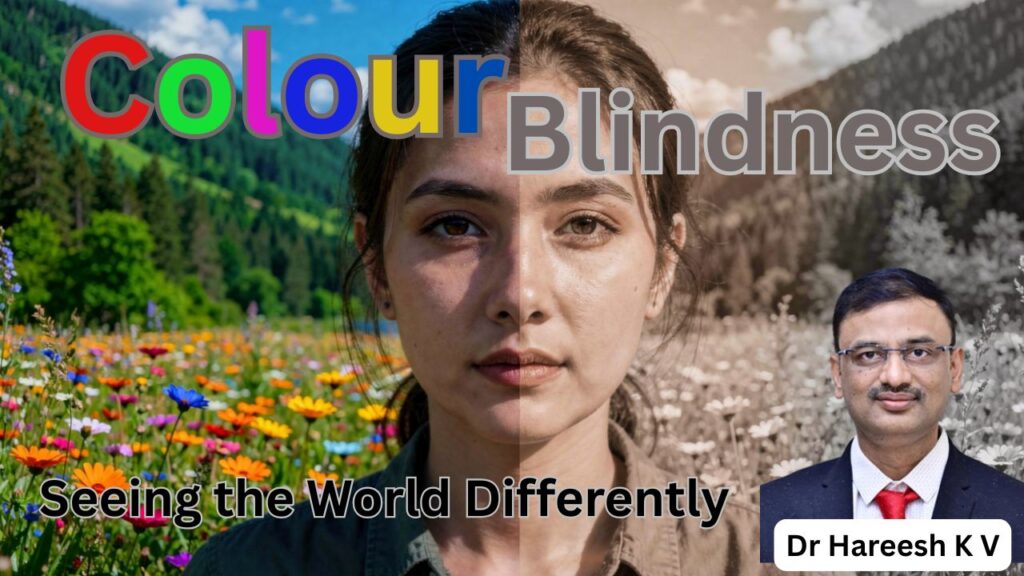
Colour Blindness – Seeing the World Differently. Colour blindness doesn’t limit a person’s ability to see the world—it simply changes how they perceive it. It doesn’t mean seeing only black and white; rather, it involves difficulty distinguishing between certain colours.

Colour is an essential part of how we experience the world—from recognizing traffic signals to enjoying a vibrant sunset. But for millions of people, colours don’t appear the way most of us see them. This condition, commonly known as colour blindness, is more accurately called colour vision deficiency (CVD).
Colour blindness occurs when the eye’s cone cells—specialized cells in the retina responsible for detecting colour—don’t function properly. These cones respond to different wavelengths of light, allowing us to perceive a full spectrum of colours. When one or more types of cones are missing or not working correctly, colour perception is altered.
Types of Colour Blindness
There are several types of colour vision deficiency, depending on which cones are affected:
• Red-Green Colour Blindness (most common) – Difficulty distinguishing between red and green shades. Includes: Protanomaly (reduced sensitivity to red); and Deuteranomaly (reduced sensitivity to green).
• Blue-Yellow Colour Blindness – Trouble telling blue from green or yellow from violet.
• Complete Colour Blindness (Achromatopsia)- A rare condition where a person sees no colour at all, only shades of gray.
Causes and Risk Factors
Colour blindness is usually inherited, caused by genetic changes passed down from parents. It is more common in men because the genes responsible are often linked to the X chromosome.
However, it can also be acquired due to: Eye diseases (like glaucoma or macular degeneration); Aging; Certain medications; and Injury to the eye or brain.
Signs and Symptoms
Many people may not realize they have colour blindness until tested. Common signs include:
• Difficulty distinguishing between red and green or blue and yellow
• Trouble reading colour-coded charts, maps, or graphs
• Confusion with traffic light colours
• Seeing colours as dull or faded
In children, it may show up as difficulty in learning colours or frequent mistakes in colouring tasks.
Diagnosis
Colour blindness is typically diagnosed using simple eye tests such as the Ishihara colour test, where a person identifies numbers hidden within dots of different colours. Eye specialists may also use advanced tests for more precise evaluation.
Living with Colour Blindness
While there is no universal cure for inherited colour blindness, most people adapt well. Strategies that can help include:
• Memorizing the position of traffic lights rather than relying on colour
• Labeling clothing or organizing wardrobes carefully
• Using mobile apps designed to identify colours
• Choosing high-contrast settings in digital devices
Special lenses and glasses are also available that may enhance colour perception for some individuals.
Impact on Daily Life
Colour blindness can influence career choices and daily tasks. Certain professions—such as pilots, electricians, or graphic designers—may require accurate colour vision. However, with awareness and the right tools, most individuals lead completely normal and successful lives.
Also read articles of Dr Hareesh K V


Dr Hareesh K V
Medical director
Abhishek Nethradhama
Krupa Bindu, No.971/37, Mig 15Th A Cross, A Sector
Khb High Rise Apartment
Ambedkar Colony, Yelahanka New town
Bengaluru -64
Ph: 080-4093 3219/77957 15203
Eye Hospital in Yelahanka new town – Abhishek Nethradhama